
Quantum Pass
Unyoke
See every permission your QoreChain account has given away, on both lanes, and take it back.
About
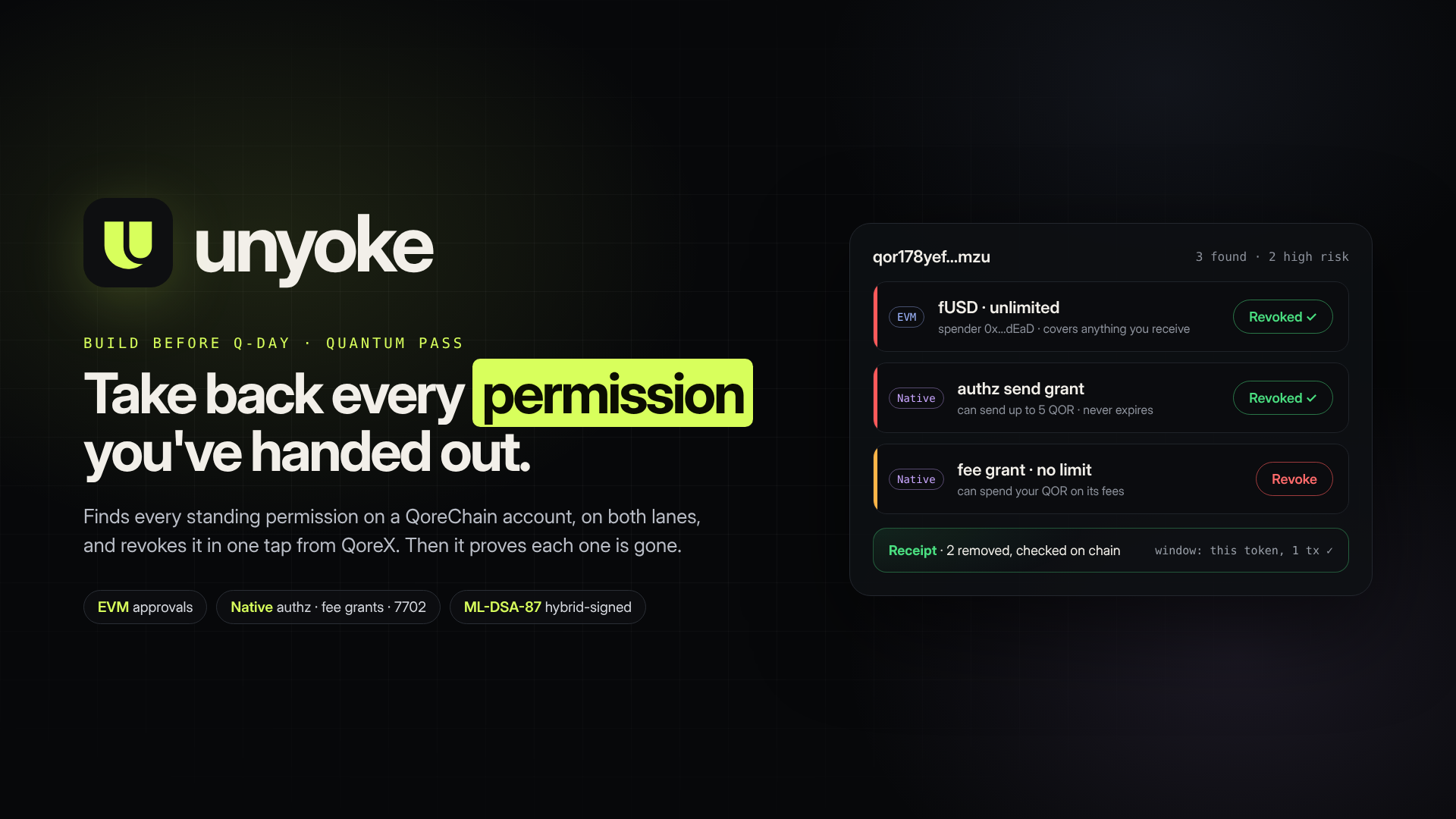
A QoreChain account can hand out standing permissions: ERC-20 approvals and NFT approve-all on the EVM lane, and authz grants, fee grants and EIP-7702 consent on the native lane. Each keeps working until it's removed, long after the app that asked is forgotten. QoreX can sign a revoke, but nothing showed you what to revoke, on either lane. Unyoke scans any qor1 or 0x address across both lanes, explains each permission in plain words with a high/medium/low risk rating, and revokes it in one tap from QoreX. Native revokes are hybrid-signed (secp256k1 + ML-DSA-87). Each token revoke goes through a post-quantum window that QoreX scopes to that one token and one transaction. After every revoke, Unyoke reads the chain again to prove the permission is gone, then adds it to a receipt with the transaction and the exact window used. Every scan also shows: - Revoke history: permissions the account already removed, with any tool, read from the chain. - The account's post-quantum key: registered, and proven with a proof of possession, read on chain by Unyoke's own PqcKeyCheck contract. - A transaction page for every revoke, with what it did and the window that admitted it. Why it matters for Q-Day: every standing permission is a promise made with yesterday's keys that keeps working tomorrow. An approval to an ordinary wallet is only as safe as that wallet's secp256k1 key. QoreChain's windows protect new transactions, but we showed on testnet that an approval stays open after its window is used up. Unyoke finds those and removes them. Read-only scanning works for anyone, with no wallet. On a desktop, Unyoke checks the account's window before a wallet signs, explains why a token revoke can't go through there, and hands off to the QoreX app with a QR code. A testnet sandbox creates harmless permissions (to 0x…dEaD) so judges can try a full revoke in two minutes. Light and dark themes.
How it's made
Vite + React + wagmi/viem, started from create-qorechain-dapp, with @qorechain/sdk, @qorechain/evm and the QoreX integrations. Static site behind Caddy on a VPS. No backend, no keys, no database. 99 unit tests, plus an end-to-end check on testnet (pnpm e2e:testnet, 18/18) that creates, scans, revokes and re-scans with Unyoke's own code. The landing page loads light (about 290 KB); the scanner's SDK code loads only when it's opened. EVM lane: Approval and ApprovalForAll events are scanned in 10,000-block chunks, 4 at a time. Then the live allowance() / isApprovedForAll() is read for each pair, so only permissions that are open now are shown. The public node keeps history only from block 8,790,799; Unyoke finds that limit and says so on every scan instead of showing a false "all clear". Native lane: the authz, feegrant and EVM-delegation-consent REST endpoints are read in full (every page), and the revoke messages are built (MsgRevoke, MsgRevokeAllowance, MsgClearEVMDelegation) and sent through QoreX's signAndBroadcast. Grants that hand over more than their name says (MsgGrant, MsgExec, MsgSetWithdrawAddress, lane conversions) are rated high. A read-only Caddy relay is needed because the REST API sends no CORS headers. PqcKeyCheck (contracts/PqcKeyCheck.sol, testnet 0xC4d2b554BE4014656cf5938b5e2F0561011Cb5f9): a small read-only contract that calls the PQC Key Status precompile (0x…0a02) and returns whether the key is registered and proven. It reverts if the precompile returns empty data, so an inactive network never reads as "no key". Each scan calls it. Testnet scripts in the repo, all from a throwaway project account: deploy PqcKeyCheck through a 1-transaction window, swap in the native AMM pool with the most QOR (with a quote-based minimum out), and publish a QoreSeal ML-KEM-1024 key derived with @qorechain/qoreseal. What was hard: - The EVM window. QoreX refuses MsgOpenEVMWindow from websites; instead QoreX mobile opens its own window per EVM transaction (one contract, 1 tx, 100 blocks). Unyoke reads the window back after each revoke and puts it on the receipt as proof. - Desktop wallets can't open windows, and Keplr reports the chain's refusal as "unknown RPC error". Unyoke checks the window first, explains it in plain words, and offers a QR hand-off that opens the same scan inside the QoreX app. - Cosmos-style accounts (QoreX's default) can't sign EVM transactions. Unyoke detects the account kind and says so instead of offering a token revoke that can't work. - The explorer can't open 0x EVM hashes, so Unyoke has its own transaction page that reads testnet directly, including which window admitted each EVM transaction and which contract a deployment created. Spike results and every testnet transaction are in docs/SPIKE_RESULTS.md and the README. AI usage is documented in AI_USAGE.md.
Timeline
Comments and questions
- No comments yet.