
Pushed 1 commit to main
- 94c2437 README: Build Before Q-Day badge · apeirs
Encrypted Apps
Report a bug to a QoreChain project, sealed in your browser to its post-quantum key. The chain records who was first.
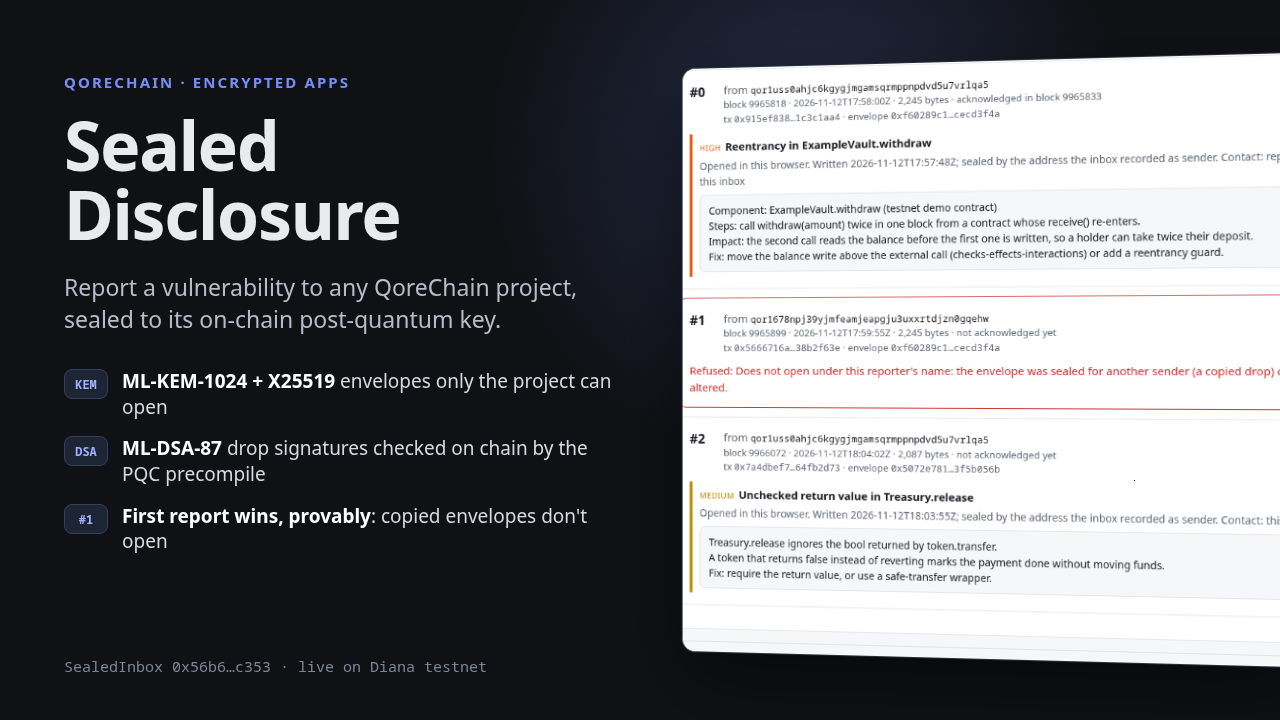
Sealed Disclosure is a post-quantum vulnerability-report inbox for QoreChain projects. A researcher who finds a bug today can post it publicly or mail it somewhere and hope. Neither keeps it secret from everyone else, and neither proves who reported first. Here a project registers an ML-KEM-1024 key in QoreChain's KEM key registry and publishes a recipient card signed with its ML-DSA-87 key. A reporter's browser checks both keys and the card against the chain, then seals the report in the tab (QoreSeal: ML-KEM-1024 + X25519, AES-256-GCM). The reporter signs a drop statement with their ML-DSA-87 key and the SealedInbox contract checks that signature on chain with the PQC precompiles before it stores the drop and its block. The project opens its inbox in its own browser with a decrypt-only seal key and can answer with an ML-DSA-87-signed receipt. The envelope names its sender, so a copied envelope dropped under another account never opens: the genuine first report keeps its place. Drop #1 on testnet is exactly that test. Try it: on the demo site, ?inbox=demo&key=demo opens the demo project's inbox and decrypts it in your browser. Live on qorechain-diana: SealedInbox 0x56b6706d009db5357ee076e62c7c7e317e45c353 (bytecode verified against the source), demo project qor1knxej2kffzpx9hcfjd54argxj72vs962nw60fg, drop 0x915ef838efdaeee4749fa70764dc7385da2f93bebc51b57dedc59dd21c3c1aa4, receipt 0xf1826ed8d2386cd445157546f03fe1b20e3c19660ad1fe133ba313713e00e73a.
Scaffolded with create-qorechain-dapp 0.13.1 (fullstack-web). React + Vite web app and a TypeScript CLI (sd) share one core. Keys: @qorechain/sdk registers the ML-DSA-87 key with proof of possession and the ML-KEM-1024 key (MsgRegisterKEMKey), both hybrid-signed. QoreSeal derives the ML-KEM and X25519 keys from the mnemonic through a one-way HKDF, so the seal key that opens reports cannot sign or spend. Contract: SealedInbox (Solidity 0.8.24, via-IR). publishCard, drop and acknowledge rebuild the exact text the key signed (chain, inbox, both qor1 addresses, the envelope's SHA-256; bech32 encoded in Solidity), read the key from the PQC Key Status precompile (0x0a02, proof of possession required) and verify with PQC Verify (0x0a01). Older cards cannot be replayed. Writes go through a hybrid-signed EVM window scoped to the inbox, one transaction at most. Browser: sealing and opening run in the tab. The only server code is a GET-only gateway for the two key queries, because the REST API sends no CORS headers. Hosted as one Cloudflare Worker. Tests: 20 offline unit tests; 17 live negative checks as free eth_calls (replays, wrong signer, older card, wrong chain, copied, tampered and mis-keyed envelopes); a headless browser run that seals in the page, drops with the CLI and opens in the page; CI recompiles the contract and checks the artifact. What was hard: making the contract's statement text byte-equal to QoreSign's signMessage, and browser wallets cannot sign an arbitrary ML-DSA-87 message yet, so the drop is signed in the CLI. MIT licence.
Pushed 1 commit to main
New project.