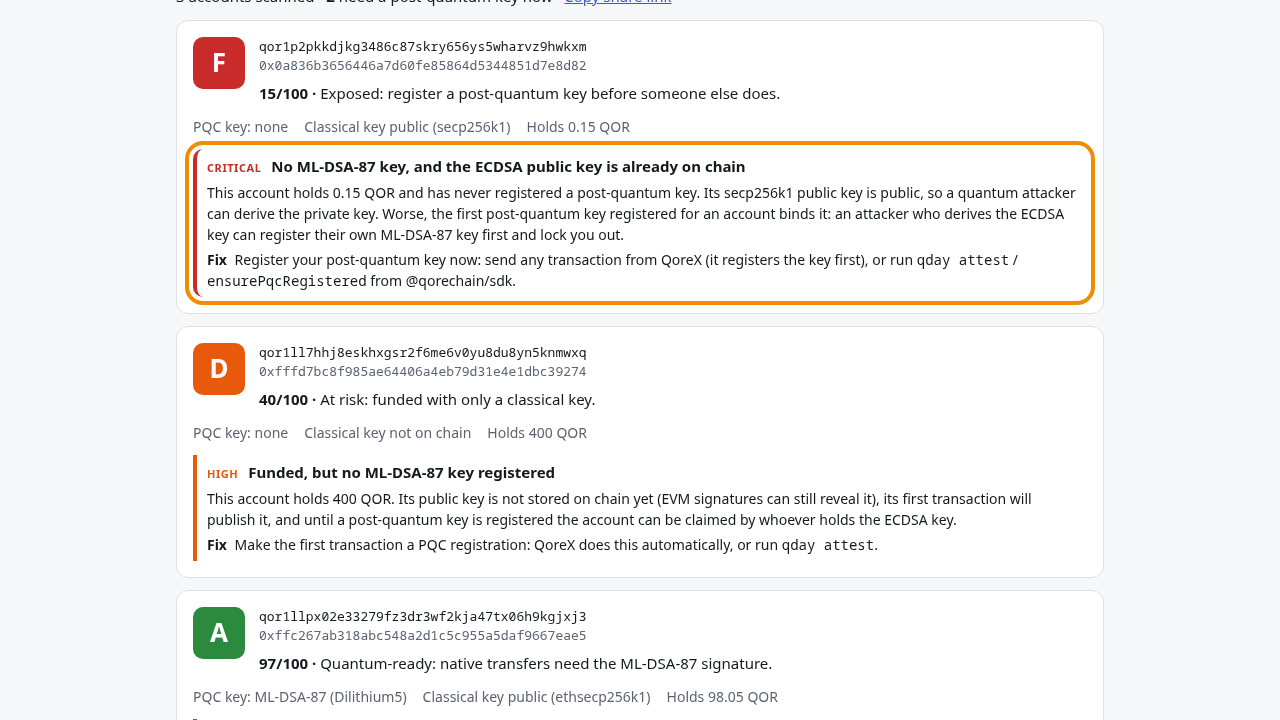
Which QoreChain accounts would a quantum attacker take first? Q-Day Readiness Audit scans any qor1 or 0x address, grades it A to F, explains the exposure and gives the one thing to fix.
QoreChain protects an account with a post-quantum key only after that key is registered. Until then it is guarded by ECDSA alone, and once its public key is on chain a large enough quantum computer can derive the private key. Worse, the first ML-DSA-87 key registered binds the account, so an attacker could register theirs first and lock the owner out. The fix is cheap and one-time, but you have to know which accounts still need it.
What it checks: ML-DSA-87 key registered (critical if a funded account has a public ECDSA key and no PQC key), funded accounts whose key is not yet public, proof of possession, open EVM authorisation windows, EIP-7702 delegations and extra authenticators on abstract accounts.
It also reads the network's live PQC policy (hybrid signatures required or not, classical-only fallback, security level) and inspects the registered ML-DSA-87 key itself: 2,592-byte size, SHA-256 fingerprint and the classical key bound to it.
Then prove it: "Attest with QoreX" (or qday attest) sends 0.000001 QOR to yourself with a memo recording your grade. QoreChain requires an ML-DSA-87 signature next to the classical one, so the transaction itself is the proof. Anyone can verify it in the app or with qday verify: both signatures are checked against the registered key with QoreSign. Share a scan with ?a= and a result with ?tx=.
The qday CLI does the same in batches and exits 1 on a critical finding, so it can gate a CI job or a treasury check.
On-chain record: QDayRegistry, deployed on qorechain-diana (EVM 9800) at 0xfcDd726E5cAeb40df793560F3FbbdBC669F0354A (deploy tx 0xbf86da9725961930daad2c38e157071b7f746f13b4e3a64ca285312abe3ca999), keeps each account's latest attestation after checking its ML-DSA-87 signature with the chain's PQC precompiles. Other contracts can gate on isReady(account, minReadiness); Verify shows whether a transaction is recorded there.
Live demo: https://qday-readiness.apeir.workers.dev (one-click examples graded F, D and A, and an example attestation to verify)
Attestations on qorechain-diana: 6B8EED3EC26B019CB9485BEFFC6B5F81DB04A59F54703A404DB539852ED045F8 (web app) and 3DC0994B1BFF78D1ECA2D90CFCE02DF08CA54A0FDADAFA87BB23A6C769D2113B (CLI), from qor1ay8cveqak7yx8wd4us9mk8q7eak3dj56nz545m.
CI: GitHub Actions runs the unit tests, type-check and build, a secret check, a Worker dry run and a contract recompile that fails if the committed artifact differs from the source, on every push.
How it's made
Scaffolded with create-qorechain-dapp twice, both runs committed unmodified: 0.13.0 (viem + wagmi template) for the app and 0.13.1 (evm-solidity template) for contracts/, which holds QDayRegistry. create-qorechain-dapp is a pinned devDependency. React + Vite web app with RainbowKit and the QoreX native lane (@qorechain/qorex-types, @qorechain/qorex-rainbowkit), plus a TypeScript CLI (qday) sharing the same core.
Scanning reads public chain state: cosmos auth/bank/staking, qorechain/pqc/v1 (account key, possession_proven, evm_window, delegation consent, and the network policy from pqc/v1/params), qorechain/abstractaccount/v1 and eth_getCode for EIP-7702 delegations. Each finding has a weight; readiness is 100 minus exposure.
Attesting uses @qorechain/sdk: ensurePqcRegistered registers the ML-DSA-87 key first if needed, then a hybrid-signed MsgSend (secp256k1 + ML-DSA-87) carries the memo qday:v1;<address>;<grade>;<readiness>;<scan digest>. Verifying uses @qorechain/qoresign inspectTransaction to check both signatures against the registered key and decodes the memo.
QDayRegistry (solc 0.8.24) takes a native attestation tx's sign-bytes and ML-DSA-87 signature, checks the key with precompile 0x0a02 (registered, proof of possession) and the signature with 0x0a01, parses chain id, memo and sequence itself and accepts only newer sequences. The CLI deploys it (qday deploy-registry) and relays attestations (qday record; qday attest relays by default).
Hosting: one Cloudflare Worker. Static assets serve the app; the Worker runs a small gateway at /chain/<network>/ because QoreChain's REST and RPC send no CORS headers. It forwards GET on an allowlist, refuses path tricks (.., %2e, //, backslashes), and has one write route for wallet broadcasts (testnet only, JSON, 64 KB cap, SYNC mode). The same gateway code runs under Vite and a plain Node server for self-hosting.
What was hard: the scaffold's typecheck fails with viem 2.57.18 (pinned 2.57.5); cosmjs 0.39 fromBech32 needs a length limit with the new @scure/base; and since hybrid mode is required on both networks, almost every account that ever sent a tx is already registered, so the real exposure is funded-but-never-sent accounts, EVM windows, 7702 delegations and authenticators. Browser tests use @qorechain/qorex-wallet-mock with Playwright. MIT licence.
13a994fREADME: judge quick path, our own tx in the CLI example, forgeable-key and unseen rows, whoami key origin, e2e in Tests· apeirs
6081698Keyless browser e2e (npm run test:e2e): examples, dark/mobile, unseen address, verify deep link, QoreX mock with a throwaway key; broadcasts blocked and counted· apeirs
e8f4137CLI: whoami checks where the registered ML-DSA-87 key comes from (flags one computed from the ECDSA key); clear missing-key message; no false 'policy unreadable' line; unknown commands exit 2· apeirs
a328a39Flag a registered ML-DSA-87 key anyone can forge (t1 all zero), with a test that forges a signature; an address with no PQC key no longer grades A· apeirs
d2f5060README: re-recorded demo video (2:46) and the new registered-key still· apeirs