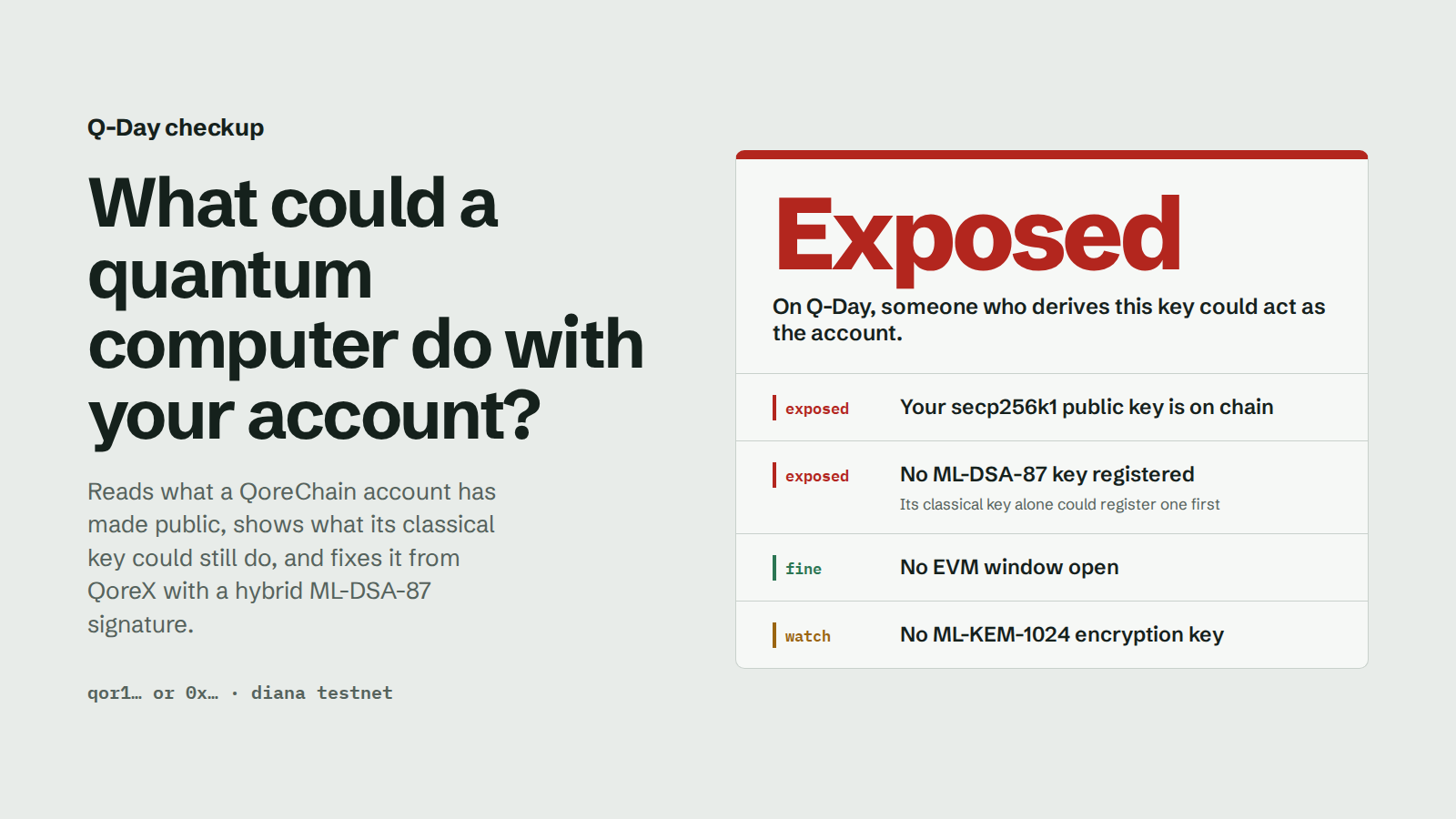
A quantum computer large enough to run Shor's algorithm turns any public secp256k1 key into its private key. Q-Day checkup reads what a QoreChain account has already made public on the diana testnet and tells you, in plain words, what that key could still do: whether its public key is on chain, whether a proven ML-DSA-87 key protects it, whether an open EVM window lets the classical key spend alone, and whether anyone can seal data to it with ML-KEM-1024. Then it lets you fix what it found from QoreX, with transactions QoreX signs with secp256k1 and ML-DSA-87 together: close or narrow an EVM window, or put the checkup itself on chain.
Before writing a word of the verdicts, it measured the chain: none of the last 500 successful transfers was signed classically alone, but 49 of the last 50 post-quantum key registrations were. So until an account registers its own ML-DSA-87 key, whoever registers one first controls it after Q-Day. The checkup says so, and tells you how to fix it.
How it's made
- Scaffolded with `create-qorechain-dapp` (viem-wagmi template): Vite, React, wagmi and RainbowKit, with QoreX through `@qorechain/qorex-rainbowkit` for the EVM lane and `@qorechain/qorex-types` for the native lane.
- The checkup reads diana's REST API (account public key, `qorechain/pqc/v1/account`, `kem`, `evm_window` via `evmWindowStatus` from `@qorechain/evm`) and the EVM RPC (nonce). The REST API sends no CORS headers, so Vercel rewrites exactly the four read paths the page uses; nothing else is proxied.
- Fixes are native-lane messages built with `@qorechain/sdk` (`MsgCloseEVMWindow`, `MsgOpenEVMWindow`, `MsgSend`) and sent with QoreX's `signAndBroadcast`, which adds the ML-DSA-87 layer and reports whether the committed transaction kept it. Registering a post-quantum key is wallet-only, so the page sends you to QoreX for that.
- Tests: stubbed chain states pin every verdict; every fix runs against `@qorechain/qorex-wallet-mock` with the user refusing, so nothing is spent; a daily Playwright run checks the live site.
- Hard part: deciding verdicts that are true. A first draft rated every account that had ever transacted as at risk forever; the rule now accounts for the hybrid-signature requirement once a proven ML-DSA-87 key is registered.