
New project.
Encrypted Apps
Post-quantum confidential invoicing, 1-tx team payroll, and everyday private payments on QoreChain with Escrow.
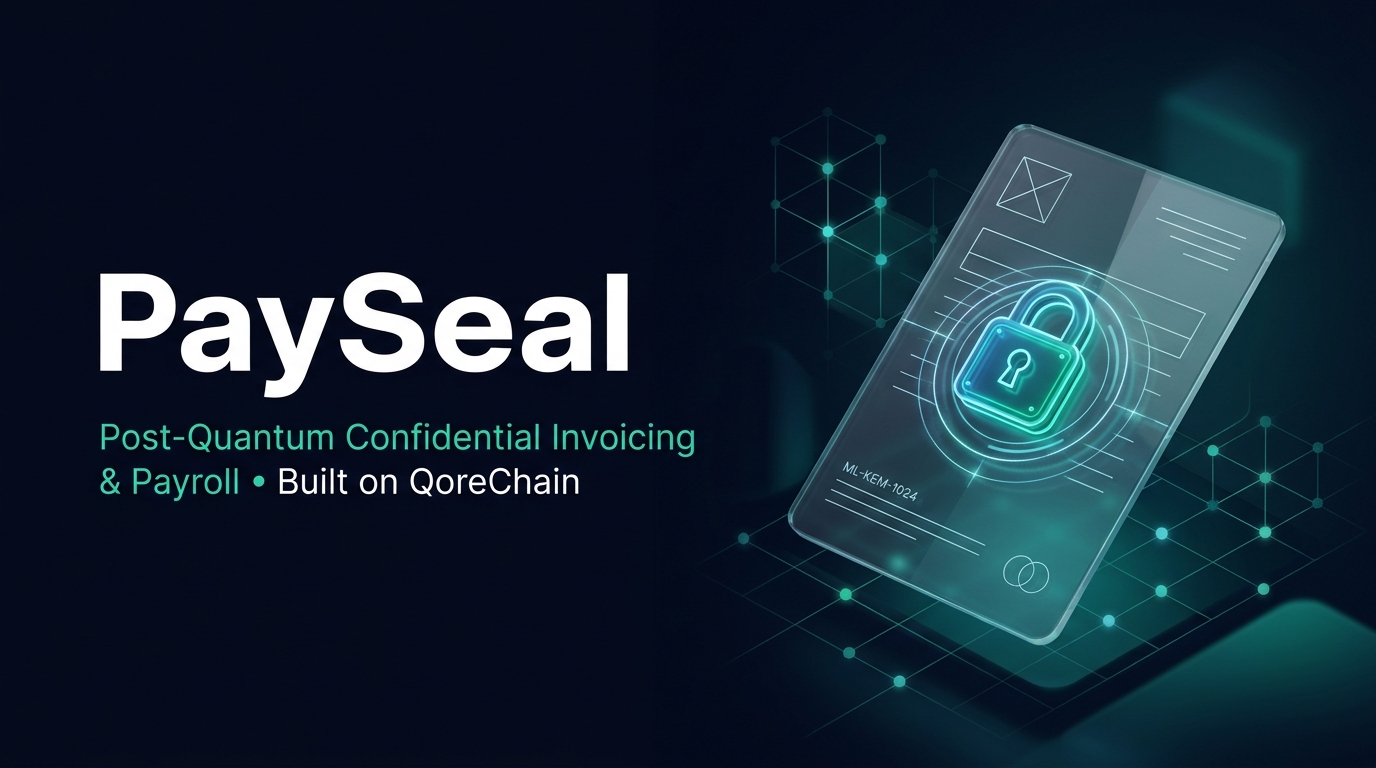
THE PROBLEM On today's public blockchains, paying rent, splitting dinner with friends, invoicing a freelance client, or running company payroll exposes sensitive business and personal details forever. Worse, even if someone encrypts payment memos with classical encryption today, an attacker can save that on-chain ciphertext and crack it once quantum computers arrive ("Harvest Now, Decrypt Later"). WHAT PAYSEAL DOES PaySeal is a quantum-safe confidential payments, invoicing, and payroll app built on QoreChain Diana Testnet (Chain ID 9800) for freelancers, everyday users, and businesses: 1. Client-Side Quantum Encryption (ML-KEM-1024 + X25519): Payment memos, itemized freelance invoices, rent receipts, and employee pay stubs are encrypted directly in the browser using @qorechain/qoreseal before touching the blockchain. Only the intended recipient(s) can decrypt them. 2. Verified Recipient Key Directory (PaySealKeyDirectory.sol): Users register their ML-KEM-1024 + X25519 Recipient Card and optional human-readable handle (@alice.qor) on-chain. The contract verifies their ML-DSA-87 key status via pqcKeyStatus (0x...0a02) and binds the card using pqcVerify (0x...0a01). 3. 1-Transaction Confidential Batch Payroll: Employers pay an entire team in QOR, fUSD, fETH, or fBTC in a single EVM transaction. Each employee receives their own individually encrypted pay stub so Alice cannot read Carol's salary, while the employer can audit the full run. 4. Optional Accountant / Tax Auditor View Keys: Attach a scoped quarterly view key (for example, 2026-Q4) to any invoice or payroll batch so a tax accountant can decrypt and verify only that quarter's receipts without ever touching wallet funds. 5. Quantum-Locked Escrow (pqcVerify at 0x...0a01): Optional escrow mode locks funds until the payer signs a 4,627-byte ML-DSA-87 post-quantum signature verified on-chain. Even if a hacker steals the payer's classical MetaMask key, escrowed funds cannot be released or refunded without the quantum key. SECURITY & THREAT MODEL - Starter Template Security Audit: Audited every file in create-qorechain-dapp@0.14.0 before installing dependencies (zero remote injection or malicious scripts). - No Classical Key Drain: Escrow releases and key card updates require pqcVerify (0x...0a01), possessionProven from pqcKeyStatus (0x...0a02), and Scoped EVM Windows. - XSS-Safe UI: All decrypted memos and invoice notes are rendered as strict plain-text nodes.
We started by auditing the official create-qorechain-dapp@0.14.0 (hardhat and viem-wagmi) starter templates line-by-line to guarantee a clean, injection-free base. From there, we built two Solidity 0.8.28 smart contracts (PaySealKeyDirectory.sol and PaySealConfidentialPay.sol) using Hardhat 3, hardhat-deploy v2 (rocketh), OpenZeppelin Contracts v5, and TypeScript. On the cryptography side, the React + Wagmi v2 + RainbowKit + QoreX frontend encrypts every invoice, receipt, and employee pay stub directly in the browser using @qorechain/qoreseal (ML-KEM-1024 + X25519 hybrid envelopes) so plaintext never touches the blockchain. For escrow releases and key directory updates, our contracts call QoreChain's built-in pqcKeyStatus (0x...0a02) and pqcVerify (0x...0a01) precompiles -- fetching the 2,592-byte ML-DSA-87 public key dynamically (saving over 1.6M gas vs. SSTORE and supporting automatic key rotation) and stamping live PRISM consensus epochs from 0x...0C01. We also built a custom window.ts CLI to automate ML-DSA-87 / ML-KEM-1024 key registration and Scoped EVM Windows, and verified the entire flow with 8 end-to-end Hardhat 3 + QoreSeal tests.
New project.