
Encrypted Apps
DeadDrop
Expose the truth, not the source: post-quantum whistleblowing on QoreChain
About
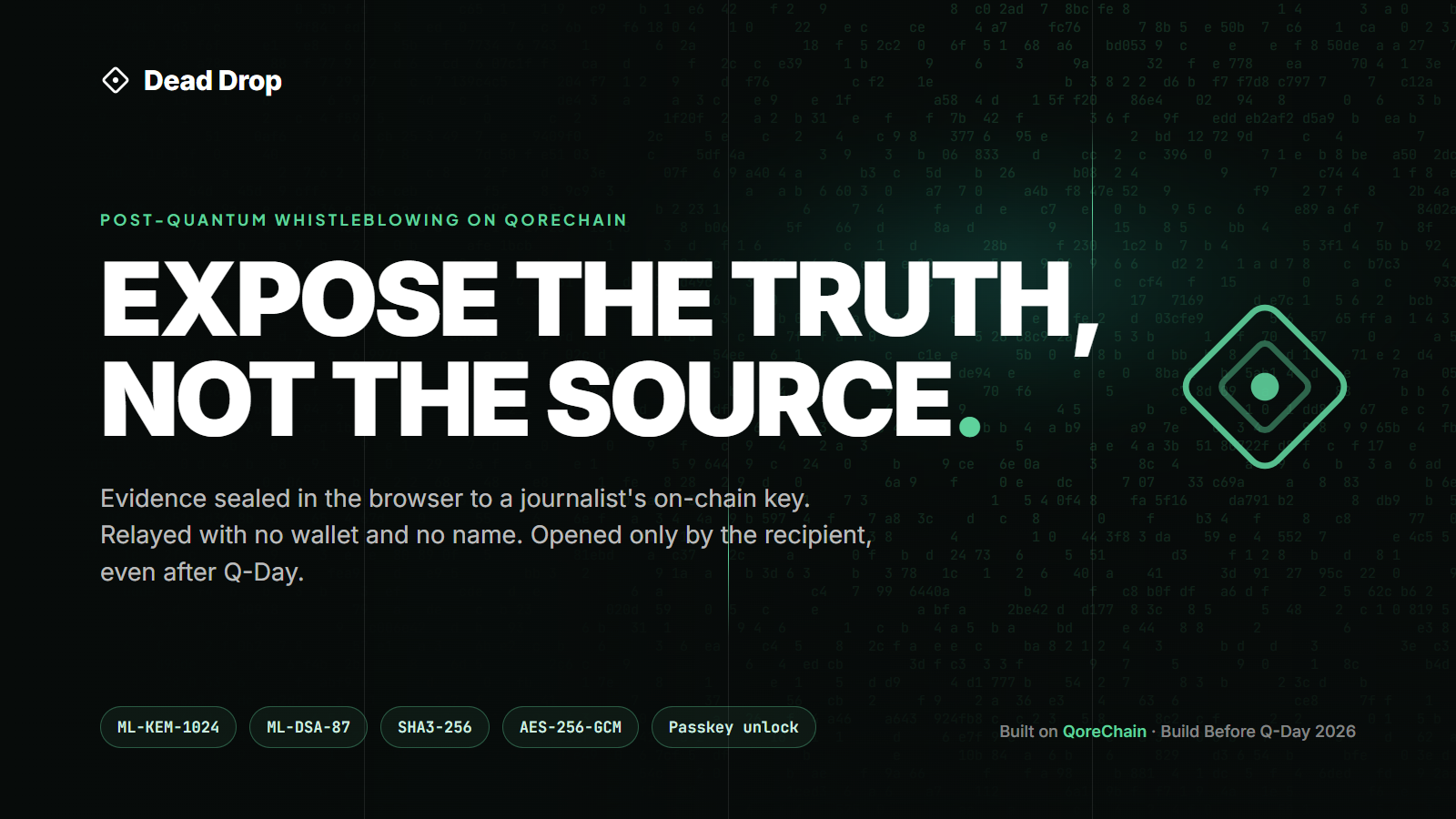
Dead Drop is a post-quantum whistleblowing app on QoreChain. A source can send evidence to a journalist so that only the journalist can ever open it, even though the encrypted file is stored publicly on chain, and even after quantum computers break today's encryption ("harvest now, decrypt later"). How it works: - Sealed in the browser: the file, its name and an optional note are encrypted on the source's device with QoreSeal (ML-KEM-1024, plus X25519 for recipients with a signed card) to the recipient's key in QoreChain's on-chain KEM registry. Plaintext never leaves the device. - No wallet, no name: a relayer with its own ML-DSA-87 key submits the envelope to the DeadDrop contract. The source never signs anything, and the server sees only ciphertext and logs nothing. - Anchored for good: the envelope's SHA3-256 hash is stored on chain. The source gets a "Proof of Silence" receipt proving the exact sealed file arrived, without revealing its contents. Anyone can check it on /verify. - Opened on one device: the journalist's inbox checks each drop's hash against the chain and decrypts locally. The recovery phrase is used only once; after that the decryption keys are locked behind a passkey (WebAuthn PRF) and can read drops but never sign or move funds. One flipped bit and the drop is refused. - Any Qore wallet can become a recipient: /become registers the wallet's ML-DSA-87 key (if missing) and its ML-KEM-1024 inbox key, signed in the browser, then gives a share link that lets anyone send to that wallet. The contract only accepts submissions from the relayer and checks its post-quantum key through the pqcKeyStatus precompile. The relayer renews its own scoped EVM window automatically. Every flow is tested end to end on the qorechain-diana testnet.
How it's made
ARCHITECTURE Three parts, all on the qorechain-diana testnet (EVM chain 9800): 1. DeadDrop.sol (Hardhat, 9 tests). submit() is relayer-only and checks the caller's ML-DSA-87 key through the pqcKeyStatus precompile (0x…0a02). It stores each envelope's SHA3-256 hash and emits the envelope inline (≤48 KB). matches(id, hash) backs the Proof of Silence receipt. setRelayer is owner-only and also requires a PQC key. 2. Next.js 15 web app. All cryptography runs in the browser: sealing on /submit, decryption on /inbox, key registration on /become. The server never sees plaintext or user keys. 3. Thin server routes: /api/relay (recomputes the hash and submits as the relayer), /api/drops (pages through Submitted events), /api/broadcast and /api/chain (explained under "What was hard"). KITS AND NETWORK FEATURES - QoreSeal: seal()/open(), deriveSealKeys, signed recipient cards (hybrid ML-KEM-1024 + X25519), and pure ML-KEM mode for wallets without a card. - QoreSign: signs recipient cards with the account's ECDSA + ML-DSA-87 keys. Senders verify every card in the browser against the keys on chain. - @qorechain/sdk: unified accounts, hybrid signing (EthNativeSigner), MsgRegisterPQCKeyV2 with proof of possession, msg.pqc.registerKemKey, openEvmWindowMsg. - On-chain KEM registry: the source of truth for every recipient's encryption key. The registration tx is hybrid-signed, so the chain itself binds key to address. - PQC precompile: the contract refuses submissions from any caller without a post-quantum key. - EVM authorisation windows: the relayer only ever has a short window scoped to the DeadDrop contract, with tx and value caps. It renews the window itself (a hybrid-signed Cosmos tx) before the ~1-day limit. - WebAuthn PRF: the inbox's decryption keys are encrypted with AES-256-GCM under a passkey-derived key, so the recovery phrase is needed only once. WHAT WAS HARD - No browser access to the chain: the testnet RPC and REST send no CORS headers. The browser signs, and our server only forwards the signed bytes. It accepts nothing but the two PQC key-registration messages, and the REST proxy is read-only and limited to the modules we need. - EVM windows expire daily: relays started failing with an opaque "Missing or invalid parameters". We surfaced the node's real error, then made the relayer renew its own window when it runs low or gets rejected. - eth_getLogs caps queries at 10,000 blocks, so drop listings page through 9,000-block chunks. - The explorer indexes txs by their Cosmos hash, not the EVM hash, so we map one to the other for every link. - Onboarding any wallet: recipient cards needed hosting, so instead we lean on the chain. A KEM key registered by a hybrid-signed tx is already proof of ownership, so senders fall back to pure ML-KEM mode. New wallets with no ML-DSA key get one registered automatically first. - Recovery phrases are too sensitive to type daily: we moved to a one-time setup plus passkey unlock, and stored keys that can read but never sign or spend. TESTING Every flow is verified on testnet with tx hashes in HISTORY.md: Node end-to-end scripts plus headless Chrome with a virtual WebAuthn authenticator (become → send → passkey unlock → decrypt → tamper refused). For the Q-Day Drill we rehearsed the attack with only the ECDSA key; native transfer, window opening, EVM transfer and contract takeover were all blocked.
Timeline
Comments and questions
- No comments yet.